

What is the science and history behind earthing and grounding?
Earthing (also known as grounding) is the practice of making direct physical contact with the Earth’s surface, either by walking barefoot outdoors or using conductive products indoors. For most of human history, people were naturally grounded through daily contact with the Earth, but modern lifestyles have largely removed this connection. Research suggests the Earth’s surface carries a subtle negative electrical charge, and that when the body makes contact, it may absorb free electrons. These electrons are thought to act as antioxidants that could help neutralize free radicals and support the body’s natural balance — effects that some studies link to reduced inflammation, better sleep, and lower stress. The science is still developing, but contemporary studies are increasingly exploring the physiological effects of this natural connection, offering an emerging scientific foundation for a practice many cultures have valued for generations.
The idea of staying connected to the Earth is an old one. Long before anyone understood electrons, people across many cultures lived in near-constant contact with the ground — barefoot, sitting and sleeping close to the earth — and many traditions valued that direct connection with nature as part of health and wellbeing. What’s new is the modern scientific lens now being applied to it.
Researchers began studying grounding more closely over the past few decades. Figures such as Dr. Stephen Sinatra, a cardiologist, and Dr. James Oschman, a biologist, helped bring attention to grounding’s possible physiological effects. Early research and reviews in this area have reported associations with reduced inflammation, better-reported sleep, and lower stress — though much of it comes from small studies, so it’s best read as promising rather than conclusive.
This growing interest has also driven practical grounding solutions — like grounding mats for the bed and earthing sheets — that let people reconnect indoors, without direct ground contact.
In-Depth Exploration: The Effects of Grounding on Inflammation
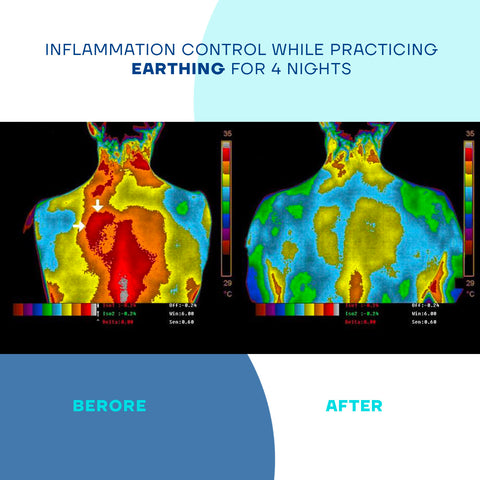
A key focus in grounding research is its possible effect on inflammation. Stressors like poor diet, inadequate sleep, and environmental toxins can drive chronic inflammation, which is linked to many health problems. Grounding’s potential role here is one of the more studied questions: the earth’s negative charge is proposed to help neutralize free radicals — the unstable molecules involved in inflammation and cellular damage. By potentially supporting the body’s response to inflammation, grounding may help support recovery and overall well-being. This is an active area of research, and the evidence, while encouraging, is still early.
Grounding in Our Technologically Advanced Era
Today’s indoor, technology-centric lifestyle has widened the physical gap between people and the earth. Much of modern life happens on surfaces insulated from the ground, which some researchers suggest may amount to a kind of ‘grounding deficiency’ — a subtle disconnection whose effects are still being explored.
In response, practical grounding solutions have emerged. Products like grounding mats, earthing sheets, and conductive footwear are designed to bridge this gap, making it easy to bring grounding into daily life.
Looking Forward: The Evolving Landscape of Grounding Practices
Grounding’s journey from an everyday part of ancestral life to a modern wellness practice reflects its lasting appeal. As ongoing research continues to explore it, grounding stands as a promising, low-risk tool for supporting health — one that blends long-held intuition with a growing body of scientific inquiry. The honest picture is that the science is still maturing, and grounding is best seen as a supportive habit rather than a proven treatment.
A Closer Look at Electrons and Health
At its core, grounding is about the body’s contact with the Earth’s electrons — but how might that influence health? The body runs on an intricate bioelectrical system, and electrons play a role in cellular function. Free electrons are thought to act as natural antioxidants, helping neutralize free radicals—the unstable molecules that can damage cells and contribute to inflammation.
When we make direct contact with the Earth, the idea is that we take up a flow of these electrons, which may help stabilize the body’s electrical environment. This proposed stabilization is one explanation offered for grounding’s reported effects — a more balanced state that may support the immune response, help with inflammation, and support healthier circadian rhythms, which in turn could improve sleep and ease stress. These are proposed mechanisms under active study, not settled facts.
Looking at this electrical side of our physiology offers an interesting perspective on why staying connected to the Earth’s surface may matter in our increasingly insulated modern lives.
Integrating Grounding into Everyday Life: Practical Tips and Tricks
While grounding mats and sheets are convenient, there are numerous other ways to incorporate grounding into your daily routine:
- Barefoot Outdoor Activities: Simply walking barefoot on grass, sand, or soil is a powerful grounding activity. Gardening, beach walks, or even a barefoot picnic in the park are great options.
- Grounding at Work: If you spend long hours indoors, a grounding desk mat under your feet can make it easy to ground while you work.
- DIY Grounding Methods: A grounding wire connected to a properly installed ground can be an affordable option — just follow the product’s safety instructions carefully.
- Mindful Grounding Exercises: Pairing mindfulness or meditation with grounding can enhance the experience. Focusing on the connection with the Earth can deepen the sense of relaxation.
- Grounding Footwear: Shoes with conductive materials let you stay grounded while walking on natural surfaces.
Small, consistent habits like these are an easy way to reconnect with nature’s rhythms in an insulated modern lifestyle.
Debunking Common Myths About Earthing
Earthing, despite its growing popularity, is often surrounded by misconceptions. Here’s an honest look at some of the most common ones:
-
Myth: Earthing is just a placebo effect.
The placebo effect is real and powerful, and it’s part of any wellness practice. That said, several small studies have also reported measurable physiological changes during grounding — such as shifts in inflammatory markers and sleep — so there appears to be more to it than placebo alone. The evidence is still early, so the picture is promising but not fully settled. -
Myth: You need to spend hours grounding to get benefits.
Even short periods of grounding can be worthwhile. Regular, consistent grounding — even if brief — tends to matter more than long, occasional sessions. -
Myth: Earthing is dangerous and can lead to electrical shocks.
Grounding is very safe when done correctly. The Earth’s natural charge is gentle, and quality grounding products are designed to transfer it safely. (As a common-sense precaution, avoid grounding outdoors during thunderstorms.) -
Myth: Grounding is a new-age concept with no historical basis.
Living in contact with the earth was simply normal for most of human history. The recent interest pairs that long-standing practice with modern scientific study. -
Myth: Special equipment is mandatory for effective grounding.
Grounding mats and sheets are convenient, but simply walking barefoot on natural surfaces like grass or sand is an effective way to ground.
This article is for educational purposes and is not medical advice. Grounding products are wellness devices and are not intended to diagnose, treat, cure, or prevent any disease. Consult your healthcare provider about your situation — and before use if you have a pacemaker or implanted device, are pregnant, or have a medical condition.